Sponsored Content
Colorectal Cancer Screening: Evidence-Based Resources, from Risk Assessment to Screening Completion
October 21, 2026
‘When you’re able to make [a] connection with your patients, that’s really what being a PA is all about.’
March 2, 2026
By Jennifer Walker
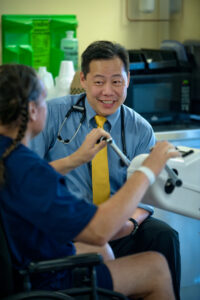
Darvin Foo, now a physician associate, had many reasons to switch careers in the mid-2000s, when he was 40 years old. A physical therapist (PT) for 17 years, he was starting to get tendinitis in his wrist from doing intricate, strenuous work with his patients. He was also thinking about the impact he wanted to make in his lifetime. And, most impactfully, he said he experienced a life-changing personal crisis when his mom found out she had cancer.
“Although at the time I had been a physical therapist for 11 years, my training was no use,” Foo wrote in his PA program personal statement. “Powerless, unable to help my mother, I began to rethink my role in healthcare. I recognized an unfilled dream to practice medicine and decided to realize it.” Sadly, his mother died one month after her diagnosis.
Foo graduated from the PA program at Emory University in Atlanta in 2009. After practicing in Atlanta for several years, he took his current position at Shriners Children’s Northern California, a pediatric specialty hospital in Sacramento, California, where he had spent 12 years as a PT. Foo, who is on the sports medicine and complex hip teams, values being able to build relationships with his patients, an aspect of his career as a PT that he also appreciated. He has even acted as a mentor to some of his young patients, particularly those who are interested in healthcare careers.
“The thing that keeps me going is those seminal, life-changing experiences with my patients that I’m fortunate enough to be a part of,” he said. “That’s why I do this.”
From Physical Therapist to Physician Associate
Growing up in San Francisco, Foo participated in a medical apprenticeship program in high school that placed him at an adult day health center for the summer. There, he rotated between working with the physicians, nurses, therapists, and dieticians. Foo was drawn to working with the therapists, who were able to connect with their patients over appointments that lasted from 30 to 45 minutes.

As a PT, Foo worked with adults for five years, primarily in neurologic rehabilitation in nonprofit or county hospital settings. “I felt like it was my calling to help the underserved people who didn’t have resources,” he said. When he injured his back due to the physically demanding work, Foo decided to try working in pediatrics. In 1995, he took a position at Shriners Children’s, located in San Francisco at the time, which provides free care to those who are uninsured and unable to pay. At Shriners, Foo worked with young patients who had orthopaedic and spinal cord injuries and burns.
After more than a decade as a PT, Foo began his PA program in 2007. “There was always something new to learn, new problems to solve, new research,” he said. “That’s part of what keeps me going as a PA.” After graduation, he worked at Shepherd Center, a large rehabilitation center in Atlanta, for six years. There, he managed three teams focused on spinal cord or brain injuries. Foo, who met his future wife and got married during this time, stayed in the city for 10 years.

But he always hoped to go back to California. In 2017, a PA position in orthopaedics opened up at Shriners in Sacramento. Today, Foo, who is fluent in Spanish, works 10 to 12 hour days and sees 16 to 22 patients a day, many of whom are young athletes who have injuries like torn ACLs or dislocated shoulders. He also sees patients who have hip conditions, including Amelia, a teenager who serendipitously ended up in his office.
A Memorable Patient Encounter
Foo met Amelia at his clinic when she was referred to Shriners for pain management, a specialty that is not offered at the hospital. At the time, Amelia was suffering from excruciating knee pain, and she had already spent four years seeing multiple providers and looking for answers and relief. She had knee surgery, but providers found no indication of what could be causing her pain. Foo quickly discerned the possible issue: Amelia seemed to have a hip problem.

“We all have this nerve that runs down the front of our hip and our thigh to our knee,” Foo said. “Often when people have an issue with their hip, sometimes they feel it in their thigh or their knee because of the nerve distribution.”
Foo did a diagnostic exam, moving Amelia’s body into three positions to see if she felt pain, and he ordered an MRI. The tests showed that she had a hip labrum tear. Foo referred Amelia to a surgeon to fix the tear.
“Magically, her pain goes from 10/10 to 0,” he said. “It was completely at random. She wasn’t even supposed to be seeing me. She was looking for pain management, and she ends up in my clinic, and it was a life-changing experience for her.”
Foo went on to counsel Amelia, who wants to be an orthopaedic surgeon. He even helped her set up an internship with The Perry Initiative, which focuses on helping young people enter the fields of orthopaedic surgery and engineering. “I’ve actually been not just a PA to her but also a mentor, and I’ve had multiple other patients who I’ve had a similar relationship with,” Foo said.
Prioritizing Connection with Patients
As a PA—and previously as a PT—Foo ensures he takes the time to learn more about his patients and build a rapport with them. He always asks them questions, from what they like to do in their free time to what they want to do after high school. “When I’m meeting a young person, I don’t just see them as a hip or a knee that needs to be fixed. I actually try to see them as a whole person who has real concerns and issues,” he said.
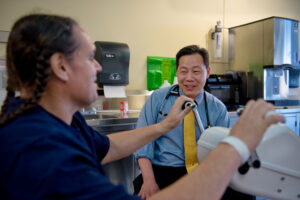
Foo remembers a recent interaction with a 15-year-old patient who had hip pain. He knows that young patients can get depressed when they are uncomfortable, achy, or sore for a long time, so he made a point of mentioning this to the patient and asking her how she was coping with the pain. At the end of the visit, the patient thanked him for asking about her feelings.
“She said, ‘You’re the first provider I’ve spoken to who actually listens to me. I feel seen, I feel heard,’” Foo said. “When you’re able to make that kind of connection with your patients, that’s really what being a PA is all about.”
You Might Also Like
A Week in Life of a PA in Orthopaedics
Prepare for the Ins and Outs of Practicing in Orthopaedic Surgery
From Addiction and Tragedy, PA Josh Thornhill Treats Body and Soul
Sponsored Content
October 21, 2026
You have 2 articles left this month. Create a free account to read more stories, or become a member for more access to exclusive benefits! Already have an account? Log in.