On a Trek to Everest Base Camp in Nepal, PA Jill Nelson Visited Medical Facilities to Learn about Wilderness Medicine
Nelson’s recent trip to Mount Everest is her biggest expedition to date
July 17, 2026
By Jennifer Walker
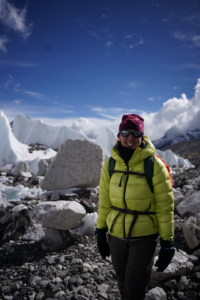
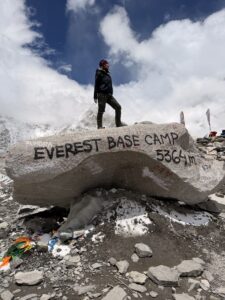
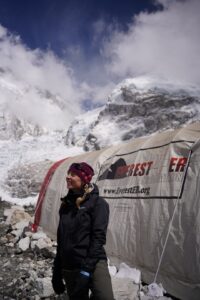
This year, physician associate Jill Nelson went on a two-week trek in Nepal that culminated in a visit to EverestER, an emergency department on Everest Base Camp at the foot of Mount Everest, the largest mountain on the planet. Sitting at 17,598 feet above sea level, this emergency department, located in a large tent, has two cots that act as patient beds and ample medications to provide “emergency medical care at the top of the world.” At EverestER, Nelson learned about the treatment of common ailments in the region, most of which are related to the increased elevation, and about providing care without the availability of testing resources like X-rays and labs.
“As a clinician who works in an urban city in a very well-stocked urgent care, it was an eye-opening experience to see how providers practice well and take great care of their patients in low-resource environments,” said Nelson, who practices at Optum Care Washington, a high-volume urgent care in Seattle, Washington.
Nelson went on this Everest trek with the Wilderness Medicine Society (WMS), an organization that offers several destination trips a year for medical professionals who want to learn about wilderness medicine and gain continuing medical education (CME) credits. Building on this interest, she attended the National Conference on Wilderness Medicine in 2022 and met many clinicians who work full-time as wilderness medical providers.
“They opened my eyes to an area that I, as a medical practitioner, could grow into that isn’t necessarily on the traditional 9-5 primary care provider track,” said Nelson, who has attended one or two wilderness medicine trips a year with WMS since 2022. “This is an area I want to learn more about.”
An Affinity for Wilderness Medicine in Nepal
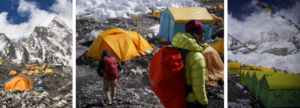
Originally from Michigan, Nelson became interested in outdoor hobbies like backpacking, mountaineering, and scuba diving when she moved to Seattle to start her PA career. Since 2022, she has traveled to France, Italy, and Switzerland, as well as Montana in the U.S., with WMS. During a 2024 trip to Annapurna Base Camp in Nepal, Nelson developed an affection for the country. “I have big love for Nepal itself: the culture, the people, the Himalayas,” she said. “I really grew a heart for Nepal on this trek and immediately knew after leaving the first time that I would be going back.”
This year’s Everest trip, which took place from late April to early May, is Nelson’s biggest expedition to date. Trekking to Everest Base Camp is a feat in and of itself that requires slowly adjusting to the increased elevation in order to have the best chance of preventing altitude sickness and other ailments. Nelson also thought this trip would be a valuable learning opportunity. “There were more site visits along the way and more providers I could speak with,” she said.
Exploring Healthcare in the Mount Everest Region
Leading up the trek, Nelson first flew into Kathmandu, the capital of Nepal, to meet her fellow travelers, then took a smaller plane to Lukla, a village that sits 9,300-plus feet above sea level and is considered to be the starting point for treks to Everest Base Camp. Most days, the group hiked to new mountain towns, each at a slightly higher elevation with lower atmospheric pressure and less oxygen. “The idea was to trek really slowly in order to acclimate well,” Nelson said. Throughout, the group took turns checking the vitals and symptoms of their fellow members to ensure everyone was healthy before moving to higher elevations.
Once they settled into each town for the night, Nelson and the group listened to evening lectures focused on general wilderness medicine topics, including conditions like traveler’s diarrhea and waterborne illness, dermatology concerns and wound care, and the importance of backcountry medical kits.
At these lectures, Nelson was most interested in learning about altitude illness, frostbite, hypothermia, and other topics related to care in the mountains. In high-elevation areas, every person is susceptible to altitude illness, regardless of their physical condition. “Altitude sickness is random with its victims. It’s not something we can out train,” Nelson said. “Even the fittest person could be attempting to summit and if they aren’t acclimatized or they go up too fast, they’re at risk just as much as a couch potato would be.”
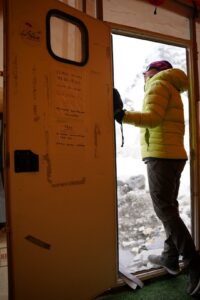
In the towns, Nelson visited a few local hospitals and clinics, where she saw firsthand the limited resources available there. For example, the supply of IV fluids and antibiotics often relies on the availability of porters, who carry the materials on their backs into the towns. As a result, the facilities sometimes have limited supplies, and providers might need to decide whether they have enough resources to stabilize a patient or whether they should send them to Kathmandu by helicopter for care.
Once Nelson reached Everest Base Camp, she was able to chat with a physician at EverestER, which provides care to porters, sherpas, and locals, as well as visiting trekkers and mountaineers. She learned the facility lacked testing resources like an X-ray machine, which would be a particularly helpful piece of equipment considering that a cough is the most common patient symptom. Providers must determine if patients have “Khumbu cough,” a common and benign hacking cough, or high-altitude pulmonary edema (HAPE), a severe, life-threatening disease in which fluids build up in the lungs. An X-ray machine would make it easier to pinpoint the cause of the cough and provide the appropriate treatment. In its absence though, the physician told Nelson she had sharpened other skills that can provide the same information.
“She had refined her auscultation skills with a stethoscope,” Nelson said. “I was blown away by the fact that she was able to manage a wide variety of conditions without all the resources I’m privileged to have in my clinic every day.”
Nelson also learned the importance of cultural awareness in providing care in the region. To illustrate this, a colleague told her a story about a patient who had a fever for more than five days. After taking several health histories, her colleague learned that the patient had witnessed a deer being brutally killed by another animal. “The belief culturally is that in order to embody the spirit of the now dead deer, it’s beneficial to drink the blood of the dead deer. So that’s what the patient did,” Nelson said. After uncovering this, providers realized that the patient had contracted rabies and were able to provide her with appropriate treatment.
“In the U.S., this would not be something that comes up often. But in Nepal, it would,” Nelson said. “This case highlights that we need to consider and be asking questions regarding cultural beliefs.”
Applying Wilderness Medicine Techniques in Seattle
Back in Seattle, Nelson envisions applying what she learned on the trek to her patient population. “We see a lot of patients coming back from wilderness and austere environments who have dermatologic changes and wound and fracture concerns from going on these expeditions in Washington,” she said. “There’s a lot of concepts that I’m going to be able to extrapolate to my urgent care work in Seattle.”
For PAs who are interested in wilderness medicine, Nelson said it’s easier to become a part of the community than they might expect. “We think we need a certain skill set or wilderness resume before we can get involved, and that’s just not true,” she said. “The Wilderness Medicine Society is driven to build community and connect people from all over the country and the world who want to gain this knowledge regardless of past experience. If you have any inkling or small amount of desire to get involved, reach out and do it.”
Jennifer Walker is a freelance writer in Baltimore, MD. Contact Jennifer at [email protected].
You Might Also Like
PA Practices Mountain Medicine In Nepal
Physician Associate Jenny Burke Responds to a Cardiac Arrest on the Ski Slope and in the Operating Room
PA Ashley Tolliver Brings Back the House Call with Redicare Mobile Health Service
You might also like


Thank you for reading AAPA’s News Central
You have 2 articles left this month. Create a free account to read more stories, or become a member for more access to exclusive benefits! Already have an account? Log in.