Your PA Compact Questions Answered: What PAs Need to Know as Progress Continues
August 6, 2026
Michigan recently became the 29th state – and fifth state in less than a month – to adopt the PA Licensure Compact, marking the most rapid multi-state passage of a PA model bill in the history of the profession.
With more than half of the country now in the PA compact, PAs across the country may be wondering: “When can I apply?”
Establishing any licensure compact – regardless of the profession – is a multi-stage, multi-year process. Thanks to funding and support from AAPA and the National Commission on Certification of Physician Assistants (NCCPA), significant progress has been made as we continue to work towards operationalizing the compact. To understand where we are in the process and what’s next, here’s a look at the work that has been done and what is still underway:
PA Compact Step #1: Model Legislation
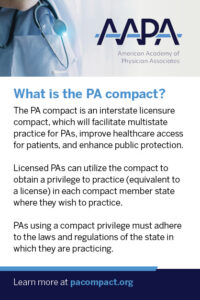 In 2019, AAPA began working on an interstate PA Licensure Compact, along with the Federation of State Medical Boards (FSMB) and NCCPA, with technical support provided by the Council of State Governments (CSG). The goal of the compact is to streamline PA licensing and expand access to care for patients.
Three years – and one pandemic later – the PA Licensure Compact model legislation was finalized in November 2022, opening the door for AAPA and state chapters to pursue state legislation and adoption of the compact.
PA Compact Step #2: Activation
The PA compact was activated when the 7th state (Virginia) enacted PA compact legislation in April 2024. This key step meant the threshold was met for the PA Compact Commission to convene and begin the process to operationalize the compact.
PA Compact Step #3: Setting Up the Compact Commission
With the seven-state threshold met in 2024, the process of operationalizing the compact began. All compacts go through a similar process, which includes establishing a Compact Commission, drafting and finalizing rules, and launching a data system for authorizing practice privileges.
The Inaugural PA Compact Commission meeting took place in Fall 2024. During that meeting, the Compact Commission elected officers and assigned committees.
Each state that enacts the PA compact appoints a delegate to the Commission. This delegate must be a state actor and be involved in regulating, licensing, and disciplining the profession. AAPA and NCCPA each have an ex-officio, non-voting delegate.
Following the first meeting, the Commission committees have continued to meet regularly. All Compact Commission meetings are open to the public, and rules are released for public comment.
The Commission has finalized several rules including a rule on the rulemaking process; a rule to establish the eligibility for a compact privilege, the process for a PA to apply for a compact privilege and designating their qualifying state; and a rule that outlines confidentiality of data maintained by the Compact Commission and information sharing by the Commission and participating states.
Two rules were recently up for public comment period and are now working their way through enactment: a rule on the process for joint investigations and requirements for member states to implement criminal background checks and a rule to establish the process for resolving disputes between states and compliance issues.
The rules committee is discussing rules around records exempt from disclosure. A rule on Commission privilege fee is awaiting the Finance Committee’s recommendation.
Both will be available for public comment upon the draft being finalized.
PA Compact Step #4: Setting Up the Data System
The Commission is currently working to set up the data system – which is the centralized technology platform that connects state regulatory boards and will allow PAs to apply for practice privileges in multiple states and allow member states to share licensure, compliance, and disciplinary information in real time.
After reviewing several Request for Proposals (RFPs) to build the PA compact data system, the PA Compact Commission’s Executive Committee voted to move forward with Focus Consulting, LLC.
PA Compact Step #5: Ongoing State Adoption
To date, 29 states have enacted the compact: Alabama, Alaska, Arizona, Arkansas, Colorado, Connecticut, Delaware, Iowa, Kansas, Maine, Michigan, Minnesota, Missouri, Montana, Nebraska, New Hampshire, New Jersey, North Carolina, North Dakota, Ohio, Oklahoma, Rhode Island, South Dakota, Tennessee, Utah, Virginia, Washington, West Virginia, and Wisconsin.
Compact bills are still in play in Massachusetts and Pennsylvania for the 2026 legislative session, and the outlook for continued progress in 2027 is strong, with multiple states poised to introduce compact legislation at the start of the new legislative session. The overall goal is for all states and territories to join the compact.
“AAPA and NCCPA are working closely with the PA Compact Commission to get the system operationalized,” said AAPA Chief of Public Affairs & Advocacy Chantell Taylor. “Momentum is on our side and AAPA is confident that we are going to see more states adopt the compact in the next state legislative season and compact privileges to become available.”
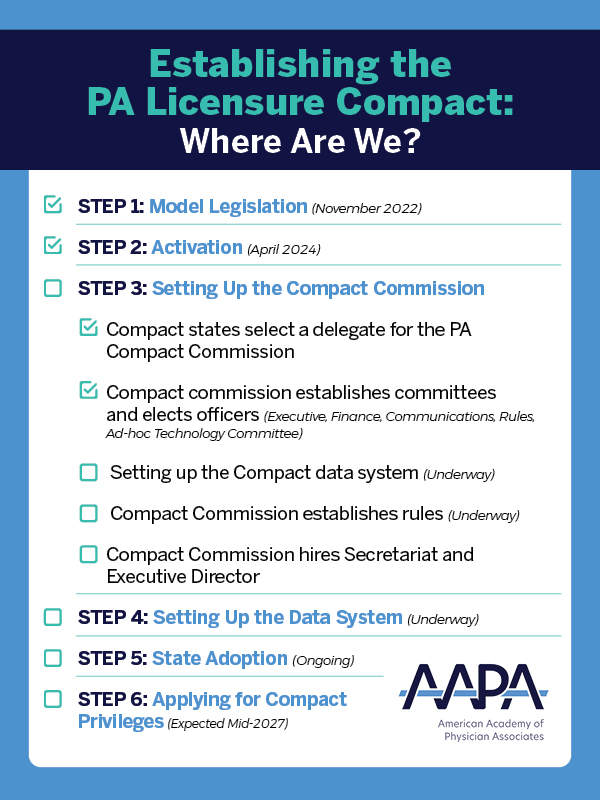
Looking Ahead: Applying for Compact Privileges
As it stands, if a state has entered the PA Compact it does not mean a PA can apply for compact privileges yet. The PA Compact Commission anticipates PAs being able to utilize the compact by early to mid-2027.
Taylor encourages PAs to frequently visit the PA Compact Commission News page, as the Commission releases quarterly newsletters. If you hold a license in a state that has not yet adopted the PA compact, AAPA encourages you to work with your State Director and state constituent organization to advocate for legislation to adopt the compact.
If your state has adopted the PA compact, AAPA encourages you to visit the PA compact website and connect with your state’s regulatory body and Compact Commissioner for updates on progress. Once the compact is operational and available for PAs to utilize, AAPA will release resources and guidance to AAPA members.
See AAPA’s FAQ for more information or contact [email protected].
You might also like