
“Every time I have encountered somebody who tells me I can’t do something, my response is, ‘Watch me.’”
July 14, 2026
By Jennifer Walker
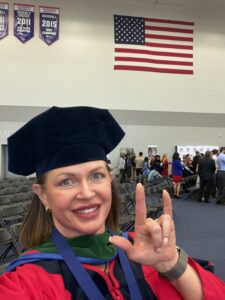
At 12 years of age, PA Kirsten Brondstater was diagnosed with bilateral sensorineural hearing loss, a condition that occurs when sound can’t reach the inner ear in both ears. She first had a hearing loss of 25 decibels, meaning she could only hear sounds that were 25 decibels or higher; two years later, her hearing loss had progressed to 40 decibels (the decibel level of a quiet room is 40, according to the American Speech-Language-Hearing Association). After her initial diagnosis, Brondstater was moved to seats that were front and center in her classrooms. When her hearing loss progressed, she got her first pair of hearing aids as a sophomore in high school. At the time, this made her diagnosis visible to those around her.
“That’s the first time that I experienced blatant prejudice and discrimination,” said Brondstater, adding that people yelled or talked more slowly with enunciated words after she got her hearing aids. “I was being spoken to like I was intellectually stunted. I don’t have the patience or tolerance for that, and that is something that I have encountered throughout my entire life.” This prejudice extended to her career: Brondstater clearly remembers an educator telling her that she would never be able to practice medicine because of her hearing impairment.
Despite these remarks, Brondstater went on to become a PA with an impressive resume. Since 2014, she has been a medical evaluator for the United States Coast Guard, a role in which she and her colleagues issue medical certificates to merchant marines, civilians who comprise the Marine Transit System in the United States. Brondstater is the second female and the 12th overall PA in the United States to hold the merchant mariner credential as a Marine Physician Assistant. In 2023, she earned her Doctor of Medical Science degree from Shenandoah University in Winchester, Virginia, and joined the faculty as an assistant professor the following semester.
Now, many years after being told she couldn’t accomplish her goals, Brondstater has become an advocate for people with hearing impairments. “Every time I have encountered somebody who tells me I can’t do something, my response is, ‘Watch me,’” she says. “I encourage other people to do the same.”

Becoming a ‘Wounded Healer’
Brondstater has practiced in pediatrics, interventional pain medicine, neurosurgery, rural medicine, and OBGYN before becoming a medical evaluator in maritime occupational medicine.
As an assistant professor at Shenandoah University, Brondstater teaches the doctoral proposal class, is a mentor for the capstone project, and has co-authored several published papers with her students. Brondstater has a deep reverence for her uncle, who served as a Marine in Vietnam, in addition to all men and women who served our country. Because of this and her son, Russell, currently serving as a combat medic, she is most thrilled about an article on optimizing care for Camp Lejeune veterans who are at risk of cancer due to exposure to volatile organic compounds.
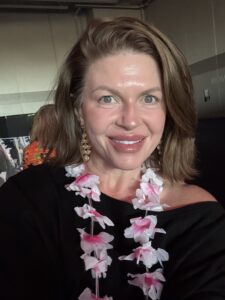
Throughout her career, Brondstater has read lips to decipher words (along with using an electronic stethoscope). “With lip reading, I have a running list of anticipatory words in my head and then am looking at the speaker’s lips to see what is spoken, which means that I am fully present when people are speaking to me,” she said. “I do have to ask people to repeat themselves if a topic changes abruptly, however this is not an issue during a patient encounter because we stay on the subject matter. Many people can hear but fail to listen, so this is actually an advantage with patient interaction because I am facing my patients and intentfully listening which makes them feel seen and heard.”
As a PA, Brondstater draws on these varied personal experiences to provide empathetic care to her patients. “I’m very much a wounded healer,” she said. “I can look them in the eyes and say, ‘I know what this was like for me, and it stinks that you’re having to go through it, too. But let’s get you to a better place together.”
Advocating for Inclusivity
Brondstater explains that the hearing-impaired population is comprised of two different communities. The deaf/Hard of Hearing (deaf/HOH) community represents people who have various degrees of hearing loss and communicate through spoken language with lip-reading and/or hearing aids. The Deaf community refers to people who were born without being able to hear and communicate with American Sign Language (ASL).
Only about 3.5% of the U.S. population is Deaf or has severe hearing difficulties functionally resulting in primarily relying on visual communication, according to The National Deaf Center. Yet in Brondstater’s experience, others react to learning about her hearing loss by offering to get an ASL interpreter — a well-meaning accommodation but one that she and the more than 50 million Americans, or about 1 in 7 people, who experience hearing loss do not need.
“When diagnosed with hearing impairment, it is inappropriately assumed you know ASL, which is an entirely different language,” she said. “This is no different than needing a pair of glasses for decreased visual acuity but being offered Braille. We need the right accommodations and that has been a continual battle. We do not live in an inclusive world and a lot of times the ‘accommodations’ that are offered are very subpar or the wrong accommodation entirely.”

Brondstater said the first step after learning about a person’s hearing loss should be to ask what the person needs. Then, one accommodation would be appropriate for the Deaf and hard-of-hearing communities: live captions, a feature that transcribes audio and video into text in real time. “That’s the right accommodation for everyone,” she said. “It’s not expensive and it’s not an unreasonable request.”
She also champions initiatives that promote inclusivity in hospitals and medical offices. For example, in waiting rooms, patients with hearing loss might not hear their name being called; they also might not be able to clearly see the staff member who is calling their name or recognize their name if it is mispronounced, both of which make it challenging for patients to read lips. Brondstater has written multiple letters suggesting an accommodation to her local diagnostic center, which was already using buzzers—similar to those used at restaurants—during the check-in process. A possible accommodation is for offices to also use the buzzers, which light up and vibrate, when it’s a patient’s turn to go to the exam room. Brondstater stated that it’s sometimes about using the resources that providers or offices already have and applying them appropriately through the scope of hearing-impaired patients. “A simple process change can drastically improve accessibility,” she added.
Promoting Inclusivity with PA Students
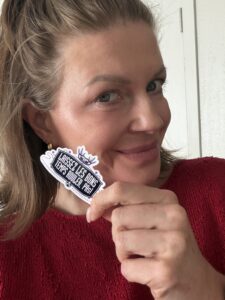
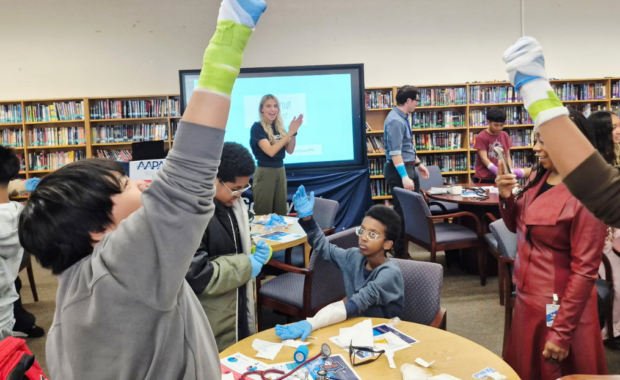
With her students, Brondstater strives to “create a ripple of positive change,” her term for turning her challenging experiences into a source of inspiration for better patient outcomes. She is open with her students about her own hearing loss and how important it is for them as future providers to look out for this condition in their patients, particularly because many people might be undiagnosed.
When caring for all patients, Brondstater also encourages the use of specific language to create positive relationships that are mutually beneficial for both parties. For example, she advocates for using the word “serve” to describe patient-provider interactions, as opposed to “help” or “fix.” “When you ‘help,’ you’re aware of your strength, and the person that you are helping is aware of their weakness. And when we ‘fix,’ we pass judgment. That’s not good,” she said. “But when we ‘serve,’ it’s an exchange of equals. You’re just as served by my interaction as I am served by yours. I have implemented that philosophy—written by Dr. Rachel Naomi Remen in her essay “In the Service of Life” in 1996—through my entire adult life and career and continue to roll it forward.”
Brondstater is holistically grateful for the obstacles she has faced because they have shaped the PA she is today. “I am blessed to have the resolve to deal with these things,” she said. “If I can advocate for change and make things better for the people who are not only still alive but also for the generations to come who could live in a more inclusive world that allows for hearing impairment to be normal, I will have succeeded.”
Jennifer Walker is a freelance writer in Baltimore, MD. Contact Jennifer at [email protected].
You May Also Like
PA Ashley Tolliver Brings Back the House Call with Redicare Mobile Health Service
PA Justice Gray Wrote a Picture Book to Encourage Self-Acceptance in her Patients
CO Outreach and Advocacy Award Recipient Fosters Inclusivity and Advances Health Equity

Sponsored Content
October 21, 2026
You have 2 articles left this month. Create a free account to read more stories, or become a member for more access to exclusive benefits! Already have an account? Log in.