“The book came from a place of wanting kids to feel safe in who they already are and not [caught up in] who they think they’re supposed to be.”
February 19, 2026
By Jennifer Walker
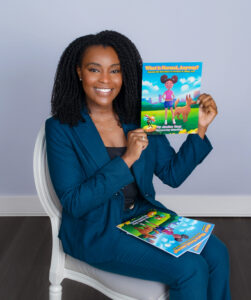
Justice Gray, a physician associate in psychiatry, spent her 4th of July holiday weekend last year writing a picture book, What is Normal Anyway? Because the Best Kind of Normal is Being You. The book follows a quiet, curious, and fidgety girl named Kacey—named after Gray’s sister—who feels different from those around her. After interactions with her classmates and animals, Kacey learns to accept herself for who she is with the help of Ms. J, Kacey’s therapist who is modeled after Gray herself. It’s a lesson that Gray strives to pass on to her pediatric patients at Bloom Health Centers in Bethesda, Maryland, who often tell her they have similar feelings.
“The book idea has been stirring in my head for years now,” said Gray. “I kept hearing the same questions over and over again from my patients: ‘Why am I like this?’ ‘Why don’t I fit in?’ ‘Why am I not normal?’ I kept seeing how early kids were comparing themselves, not just socially but emotionally. I realized that we don’t give kids the language for self-acceptance early enough, and I wanted a story that told them that they’re not broken but that they’re human.”
Gray began working in psychiatry after completing the PA program at Emory & Henry University in Marion, Virginia in 2022. At Bloom Health Centers, where she works with children and adults, Gray uses props with her younger patients, such as Inside Out characters, to encourage them identify and connect with their emotions. Her book has become another valuable tool that sometimes helps kids access and process their feelings.

“I work with a lot of kids who spend a lot of time wondering what’s wrong with them,” said Gray, who also holds a Doctor of Medical Science degree from the University of Lynchburg in Lynchburg, Virginia. “In the book, ‘normal’ isn’t really about fitting in. It’s about being okay with yourself and understanding that being different isn’t something to fix.”
For Gray, Psychiatry Found Her
As a young athlete, Gray, who cheered in high school and college, thought she would become a physical therapist (PT). After completing her undergraduate degree, she applied to a few PT schools and spent a year in a chiropractic program, but neither career felt like the right fit.
In 2018, Gray began working as a medical assistant with a general surgeon in Alabama, her home state, who took an interest in helping her figure out a path in healthcare. After surgery one day, he told Gray he had a specialty in mind that she might be interested in; later, he took her to meet an orthopaedic PA. Shortly after, Gray began applying to PA programs.

While at Emory & Henry University, Gray did a rotation at Southwest Virginia Mental Health Institute and quickly felt connected to the field of psychiatry. There, she was part of a multidisciplinary team that interviewed and evaluated patients. “I fell in love with those hidden parts of people that deserve to be listened to and understood,” she said. “People don’t understand what is important about their story until they start talking. Then they start to have a better understanding of their life and the world, and that’s where the hope comes in and the forgiveness and the love of self and others.”
After her rotation, Gray was asked to come back to the Institute to complete an active internship as her elective. She later learned the team was considering hiring her as their first PA. But Gray didn’t want to stay in Marion after graduation. “I wanted to be around people who looked more like me,” she said.
Gray took a psychiatry position in North Carolina for a year, then began her current position at Bloom Health Centers, where she works with patients from Maryland, Washington, D.C., and Virginia. Gray sees 10 to 17 patients a day for ADHD, anxiety, autism, depression, insomnia, personality disorders, psychosis, schizophrenia, and cultural differences and discrepancies. “The minority base in general chooses to navigate toward me,” she said. “I think it’s just the fact that I’m part of the minority population so maybe they feel understood a little bit more.”

Writing about Self-Acceptance
As she was thinking about writing, Gray had to examine what normal was to her, as well as how kids interpret the word. “As an adult, I can say it’s more of a social construct and it depends on who you’re around and the environment you are in,” she said. “But kids don’t really understand that. They think normal is a rule. It’s a moving target that kids end up chasing and then they never catch it and they feel like a failure. The book was written to help children feel secure in who they are rather than become consumed by who they believe they are supposed to be.”
With this in mind, Gray wrote her book over one weekend with limited editing because she wanted the book to feel raw. In creating the character of Kacey, Gray already had an inspiration: her five-year-old niece, Kai’Lani. “My niece is sometimes really shy and will hide away in corners,” she said. “I wanted the character to be a little Black girl because I don’t know what kind of struggles she’ll go through in life, and I wanted her to see herself in case she becomes someone who needs to read it.”

The next step for Gray was finding an artist “who could illustrate what people of color look like,” she said. She found this in Taiye Okoh, an overseas editor, who created proofs for Gray in less than two months. The illustrations were finished at the end of August, and she printed the book the following week.
Both as an author and as a PA, Gray wants to give children, as well as her adult patients, a sense of relief in their lives. “I hope that every time somebody leaves my office or they get off a call, they feel hopeful,” said Gray, who plans to write more books for particular populations, such as foster children, with a mental health focus. “Maybe it’s not hope within themselves, but hopeful in the connection and the communication we had, and hope that they could have hope. I want this message to land emotionally: ‘I’m okay the way I am and I’m not alone.’”
You Might Also Like
A Day in the Life of a Psychiatry PA: Bridging Clinical Care, Leadership, and Education
From Language Barriers to Medication Access Challenges, Carlos Amaya Bridges Gaps in Mental Health Services
PAs Help Expand Mental Health Services to Alaska’s Most Remote Communities

Sponsored Content
October 21, 2026
You have 2 articles left this month. Create a free account to read more stories, or become a member for more access to exclusive benefits! Already have an account? Log in.