PA Dishes Out a New Approach to Cutting Waste with Reusable Food Packaging System
“Reducing plastic waste is not simply about decreasing pollution; it is also about addressing potential health risks”
September 15, 2026
By Dave Andrews

For Ravyn Williams, PA-C, caring for patients extends beyond diagnosing and treating disease. It can also mean addressing the systems and environmental conditions that influence health.
That philosophy inspired Williams to create Taki2Go, a reuse system designed to reduce single-use food containers at the source. By pairing reusable food containers with onsite sanitization, the company aims to make reuse more practical and convenient in high-volume foodservice environments.
A Passion for Problem Solving
Reducing plastic waste is not simply about decreasing pollution; it is also about addressing potential health risks, says Williams, a PA specializing in cardiac electrophysiology based in Los Angeles. She points to a growing amount of research in recent years examining the potentially harmful effects of microplastic exposure — particularly as a risk factor for cardiovascular disease.

“Some people may not see plastic waste as a healthcare issue,” Williams said. “But I think the biggest takeaway is that environmental health is closely tied to public health, and it impacts us directly. This is especially true with microplastics that are now being detected all throughout the body.”
Williams considers reuse to be more effective than other waste-management strategies because it addresses the problem before waste is created. With Taki2Go, companies and consumers can more easily reuse containers rather than rely on more costly and time-consuming recycling methods.
Taking the Concept Further
Williams’ original idea for Taki2Go began to take shape about five years ago. She spent much of the first year researching foodservice challenges from both the community-health and business-expense perspectives, including the effectiveness of traditional recycling programs.
Her initial concept for Taki2Go catered primarily to restaurants. While the concept attracted interest from several major restaurant chains, Williams saw even broader potential. She realized the system could be adapted for larger institutions, including schools and hospitals, where substantial volumes of food are continually served and disposable packaging can quickly accumulate.
“[Schools have] been a goldmine as far as interest,” Williams said. “We recently finished a proposal for a pilot program with one of the country’s largest school districts and have completed site visits at multiple school sites to assess real-world challenges with food packaging and dishwashing.”

The school market has emerged as the primary focus for Williams. However, hospitals remain a major part of her long-term vision, and she believes they could ultimately see the greatest impact from Taki2Go.
Designing for the Real World
The environments in which Taki2Go could operate — from restaurants and schools to hospitals — require slightly different solutions. But Williams asserts the underlying concept remains consistent: an onsite sanitation station paired with reusable containers.
Williams and her team are incorporating findings from completed site visits into the system’s design. Their approach is grounded in firsthand observations of cafeteria operations and the practical needs of the people who would use it.
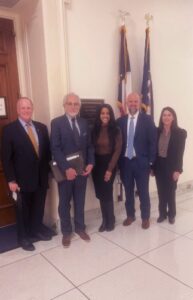
“Sustainability, whether we like it or not, is largely driven by convenience and incentives,” Williams said. “It has to work for the consumer, the food service operator, and the institution.”
Connecting with the Right People
Williams quickly learned that developing Taki2Go required more than designing new technology. She also needed to connect with people who understood the challenges she was trying to solve and the realities of implementing a new system.
“Networking is definitely a huge part of it,” she said. “You have to get to know the right people, and fortunately for me, I had a large group of advisors to lean on who have expertise spanning a lot of different backgrounds including government, the food industry, education, healthcare, and tech.”
Williams sees Taki2Go as an extension of her work as a PA and firmly believes the professional identity of physician associates doesn’t have to be confined to traditional provider roles.
“Caring for patients isn’t always solely about treating diseases,” she said. “In this case, it can also include redesigning systems and improving conditions that contribute to the disease.”
Williams thinks PAs have a tremendous opportunity to become innovators and entrepreneurs because they typically have a strong knack for working independently as well as serving as team leaders.
“There are many common threads between medicine and entrepreneurship,” she said. “We identify a problem, understand its risks, listen to the people affected, and develop a practical solution. The process of developing Taki2Go is a reflection of my approach to care.”
Williams hopes Taki2Go serves as an example of what happens when healthcare professionals apply their problem-solving skills beyond the clinic. For her, making reuse convenient is one way to turn a seemingly ordinary challenge into an opportunity to make a broader impact on public health.
You May Also Like
PA April Gulotti is Making an Impact on the Global Water Crisis
PAs Make a Lasting Impact in Remote Communities of the Peruvian Andes
PA Ashley Tolliver Brings Back the House Call with Redicare Mobile Health Service
You might also like
Thank you for reading AAPA’s News Central
You have 2 articles left this month. Create a free account to read more stories, or become a member for more access to exclusive benefits! Already have an account? Log in.