Six Mass General Brigham PAs were prepared to treat players, staff, and fans at the France vs. Morocco quarterfinals match
September 24, 2026
By Jennifer Walker
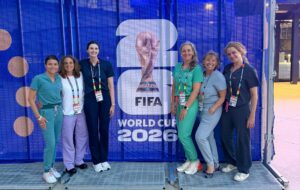
On a sweltering day in July, the national soccer teams from France and Morocco left it all on the field at Boston Stadium in Foxborough, Massachusetts, during a quarterfinal game in the 2026 FIFA World Cup.
Behind the scenes, six emergency medicine physician associates from Mass General Brigham (MGB) were at the stadium working at first aid stations treating players, staff, and spectators. Throughout the year, the stadium—normally known as Gilette Stadium, which holds more than 65,000 fans—has a contract with MGB’s emergency department to respond to emergency and urgent care needs during events. For this World Cup game, PAs were chosen to attend based on seniority. Sabrina Serino was prepared to treat players in the medical room near the tunnel entrance to the field, while Jessica Britnell cared for the community in a medical trailer in the Stadium Fan Experience area. The other four PAs were set up at health stations on the main and upper concourses.
“The energy was nothing like I’ve ever experienced at this stadium,” said Serino, manager of the 82-person PA team at Brigham and Women’s Hospital (BWH) in Boston, a founding member of the MGB healthcare system, and a lifelong soccer player and fan. “It was so exciting to see fans from different countries come together. I’m so happy I experienced this in my lifetime.”
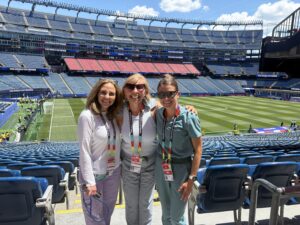
“There was no negativity; it didn’t matter who won or lost,” added Britnell, the executive director of advanced practice providers for MGB Emergency Medicine Enterprise, a role in which she oversees more than 350 providers at nine emergency departments in Massachusetts and New Hampshire. “When Mbappé scored for France, it brought the place to their feet. There was so much excitement in the stadium. For us as PAs to all experience that energy together, it was a really unique and special experience.”
Preparing for Athlete Medical Emergencies
During the match, Serino was set up in the well-stocked player medical room next to the field. “In theory, I would be caring for the players who got injured, which luckily didn’t happen,” said Serino, a former captain for the soccer team at Stonehill College in Easton, Massachusetts, and a current player in an adult league in Boston. “But it was really exciting because we had to have the entire room prepped in the event that someone really did get hurt.”
To do this, Serino arrived three hours before the game—along with emergency medicine physician Andrew Eyre from MGB—to take inventory and set up needed equipment. With the extreme temperature that day, overheating was a big concern. To be ready for this, Serino set up an ice bath, first filling a tub with water then adding ice until the temperature reached 60 degrees. “That was interesting and something that I’m not necessarily exposed to doing all the time in the emergency department,” said Serino, adding that they also had additional ice to bring the temperature down even further if needed.
Serino also referred to a four-page list of medications and equipment to take inventory of the room’s stock. There were medications for cardiac arrest, resuscitation, and sedation; splint and immobilization supplies for musculoskeletal injuries; first aid materials for lacerations and cuts; a rectal probe for accurate temperature readings; and more. She prepped medical bags for the physicians on the field, too, who would be the first to address player emergencies.
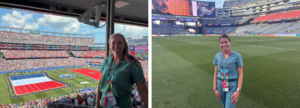
Before the match, Serino also learned about the structure of medical care at World Cup games. Each team had their own physician. Along with Serino and Eyre, the Player Field Medical Station was staffed by match physician Aaron Baggish, MGB sports medicine physicians Ashwin Babu and Kelly McGinnis, and MGB emergency medicine physician Scott Goldberg. “The station brought together a remarkable depth of expertise with specialists and highly-skilled providers prepared to manage a wide range of medical needs,” Serino said. Physician Andrew Massey, medical director for FIFA, also did a walkthrough of the player medical space before the match to ensure it was prepped and to brief the MGB team about protocol around medical issues that would be addressed on the field vs. in their medical station.
Although she didn’t need to provide care during the match, Serino rushed to help an injured fan as she was exiting the stadium. The man fell and landed on his face. “He had two lacerations, one on his nose and one on his scalp,” she said. “In patients who are heavily intoxicated and have had head trauma, we always worry about subdural hemorrhage or possible cervical spine injury. Luckily, he was awake and alert at the time. We were able to quickly control the bleeding and get him transported to a local hospital.”
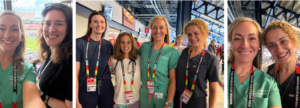
For Serino, working as a PA at the match was an unparalleled experience. “I love soccer, so this was the best opportunity ever,” she said. “I wish everyone could experience a World Cup game.”
Providing Care for Fans and Staff
Britnell was excited to work at the World Cup because she wanted to meet people and see traditions from different cultures. “I tried to ask every one of my patients where they were from,” she said. Britnell also felt a connection to the game because of her son, who plays club soccer on four teams. “Taking pictures and having that experience gave me proximity to something that he is really excited about,” she added.
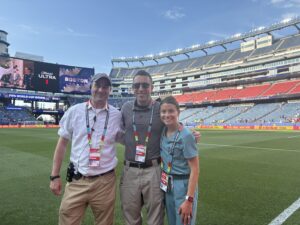
In the Stadium Fan Experience area, where she was primarily stationed along with a physician and two paramedics, Britnell was prepared to address everything from cardiac arrest and trauma to dehydration and vomiting to a need for tampons and bandages. During her eight-hour shift, she was steadily busy, mainly treating patients for dehydration and falls, as well as providing bandages for blisters.
But after Britnell moved inside to help at one of the clinics, she observed PA Hana Dubsky treating a patient who came in with supraventricular tachycardia. The patient’s heart rate was over 200, and she experienced palpitations and dizziness. Dubsky guided the patient through Valsalva maneuvers, a series of breath strain phases followed by positioning movements that can stimulate the vagus nerve pressure and decrease the heart rate. The maneuver was successful: The patient’s heart rate returned to a normal rhythm, and she could finish watching the match.
“Some of the fans who come to the clinics were really sick—they paid so much money for these tickets, and they don’t want to miss any part of the game,” Britnell said. “To see Hana—who was also my PA educator and mentor in school—convert the patient, monitor her, and be able to safely allow her to go back out to the stands and enjoy the game with her family, I felt pride. I was proud of all of the PAs on our team that provided such exceptional care and were so nimble and flexible and able to meet the needs of the stadium, the community, and our profession.”
Jennifer Walker is a freelance writer in Baltimore, MD. Contact Jennifer at [email protected].
You May Also Like
The PA Who Prescribes Authenticity in HBO’s ‘The Pitt’
On a Trek to Everest Base Camp in Nepal, PA Jill Nelson Visited Medical Facilities to Learn about Wilderness Medicine
PA Dishes Out a New Approach to Cutting Waste with Reusable Food Packaging System
You have 2 articles left this month. Create a free account to read more stories, or become a member for more access to exclusive benefits! Already have an account? Log in.