Sponsored Content
Colorectal Cancer Screening: Evidence-Based Resources, from Risk Assessment to Screening Completion
October 21, 2026
A 5-minute act of heroism gave Taylor Clayton and Julia Riordan confidence in their future as healthcare providers
January 21, 2026
By Jennifer Walker
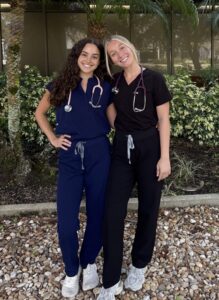
In August 2025, first-year PA students Taylor Clayton and Julia Riordan were walking on the Tampa Riverwalk when a person bolted past them. At the time, Clayton and Riordan—students in the PA program at the University of South Florida (USF) in Tampa, Florida— were taking a brain break from studying for their first round of finals.
Wearing their scrubs, they turned to see where the person was running, and noticed a person’s legs sticking out from behind a nearby tour bus. Clayton and Riordan walked closer to find a man who was unconscious and lying on the ground. They later learned the man, who appeared to be in his 80s, was with a veterans’ tour group when he fell walking up the bus steps. In the urgency of the moment, bystanders simply told them that the man didn’t have a pulse and asked if they worked in medicine.
“We said, ‘No, we are students, but we’d like to try to help. We’ll do our best,’” Riordan said. “From that point, Taylor and I looked at each other and decided this was what we were going to do and we both got in there.”
Only three months into their PA program at the time, Clayton and Riordan were thrust into their first experience providing CPR to a patient. About 16% of out-of-hospital cardiac events occur in public settings and providing CPR immediately to patients doubles or triples their chances of surviving. During these events, every second counts: A patient has a 10% lower chance of survival for every minute that CPR and use of an AED is delayed. Because Clayton and Riordan acted quickly—jumping in to give compressions, managing the crowd, and locating an AED—the patient regained consciousness and survived the episode.
Now, reflecting on the experience five months later, Clayton said, “It’s been a big boost of confidence overall that we can make a difference by implementing the Basic Life Support skills and medical teamwork training we are taught in this PA program. We have great people around us that teach us, and they empower us to feel like we’re able to step in during those situations.”
“It’s very easy to feel not fully equipped or to have a little bit of imposter syndrome this early in our medical careers,” added Riordan. “But this experience was amazing evidence for us that we are capable and we definitely are in the right field.”
Notable Early Medical Experiences
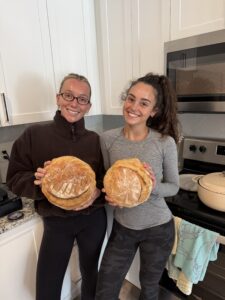
Clayton and Riordan met in May 2025 at USF’s PA program orientation. They sat next to each other and found they had similar interests and senses of humor. “We started studying together, hanging out, and definitely became besties,” Clayton said.
Both of them also had influential experiences during their childhoods that drew them to medicine. When Clayton was 10 years old, her mom was in a serious bike accident that left her with a fractured spine. She spent a couple weeks in the ICU. Back then, Clayton said, she felt she didn’t have all of the details about the severity of her mother’s injury.
“I remember thinking in that moment that I wish I had more information in regard to her condition and potential outcomes,” she said. “After that point, it became clear to me that I want to be that person who is able to bridge that information gap and provide a sense of comfort to patients and their loved ones.”
Similarly, Riordan was drawn to medicine after seeing her grandmother navigate a pancreatic cancer diagnosis along with Type 1 diabetes. Riordan helped her with medicines and changed her diabetes pump. “I was very interested in the medical side and how fondly she talked about her providers,” she said. “To this day, my grandmother loves her PA; that’s all she raves about. I want to be that person for other people.”
Working Together to Save a Life
Near the Tampa Riverwalk, Clayton and Riordan quickly sprang into action to assist the unconscious patient. Clayton started compressions while Riordan cleared the area and communicated with bystanders about calling 911 and finding an AED.
After about 90 seconds, Riordan took over compressions and Clayton went to look for an AED on the tour bus. Although, she wasn’t able to find one, a bystander located an AED in the nearby convention center.
They swapped roles one more time, with Clayton taking over compressions while Riordan cleared the man’s chest area and affixed the AED pads. By this point, an off-duty paramedic came to help and confirmed that the machine was properly set up. Riordan pressed the button on the AED and got the “Shock Not Advised” message.
“At that point, we both felt a pulse on each wrist,” Clayton said. “Shortly after, he became conscious again.”
The entire experience took five minutes.
After he woke up, the man was confused, agitated, and possibly in pain. He didn’t understand why he was on the ground and people were around him. Clayton and Riordan supported his back and made sure he was in a safe position until EMS arrived. Then they answered questions from the paramedics, confirmed that the team had everything they needed, and left the scene.
Far-Reaching Impacts
Afterward, Clayton and Riordan didn’t say much, each processing the event in their own way. The next day, their concern for the man’s condition after they left—which they do not know to this day—was weighting on their minds. But they were able to compartmentalize those feelings and do well on their last final of the semester.
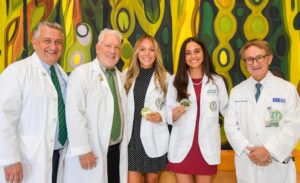
In October 2025, Clayton and Riordan were honored to be presented with USF Health Culture Coins at their white coat ceremony. At USF, these coins, which are modeled after those given to military members, are awarded to faculty, staff, and students who perform exceptional deeds.
Then in December, Clayton and Riordan were invited to speak about their experience at Tampa General Hospital’s Schwartz Rounds, a monthly program that addresses the emotional aspects of patient care. Their story fit the month’s theme about providing care outside of the hospital setting. At the event, they also met other providers who were in situations where they had to suddenly provide care to individuals while off-duty. “It was really good to share our experience with other people in the medical field and to talk with them about the power of using what you have around you and your knowledge to make a difference,” Riordan said.
Along with helping them more strongly trust their abilities, this experience has also had an impact on how Clayton and Riordan envision their future careers. “It was a pretty high-stress situation, and I think we handled it well and worked well as a team together,” said Clayton. “That makes me want to work in a team and in high-stress situations, and I feel that surgery would be a good place to explore and I might be a good fit in that area.”
Riordan is also now more aware of the ongoing responsibilities of providers outside of their shifts. “In the medical profession, you don’t ever really get to take off that cap and say, ‘I’m no longer working now,’” said Riordan, who plans to specialize in OBGYN/women’s health but now also feels more equipped and empowered to practice in emergency-type settings. “When you have these tools, you can make a difference at any time. That’s been a really big lesson.”
You Might Also Like
PA Student Isaac Esene Leads GoodWorks, a Nonprofit that Teaches Bystander Awareness to the Next Generation
During her First Marathon, PA Melissa Volpe Stopped to Save the Life of a Fellow Runner
Physician Associate Jenny Burke Responds to a Cardiac Arrest on the Ski Slope and in the Operating Room
Sponsored Content
October 21, 2026
You have 2 articles left this month. Create a free account to read more stories, or become a member for more access to exclusive benefits! Already have an account? Log in.