EHR Toolkit
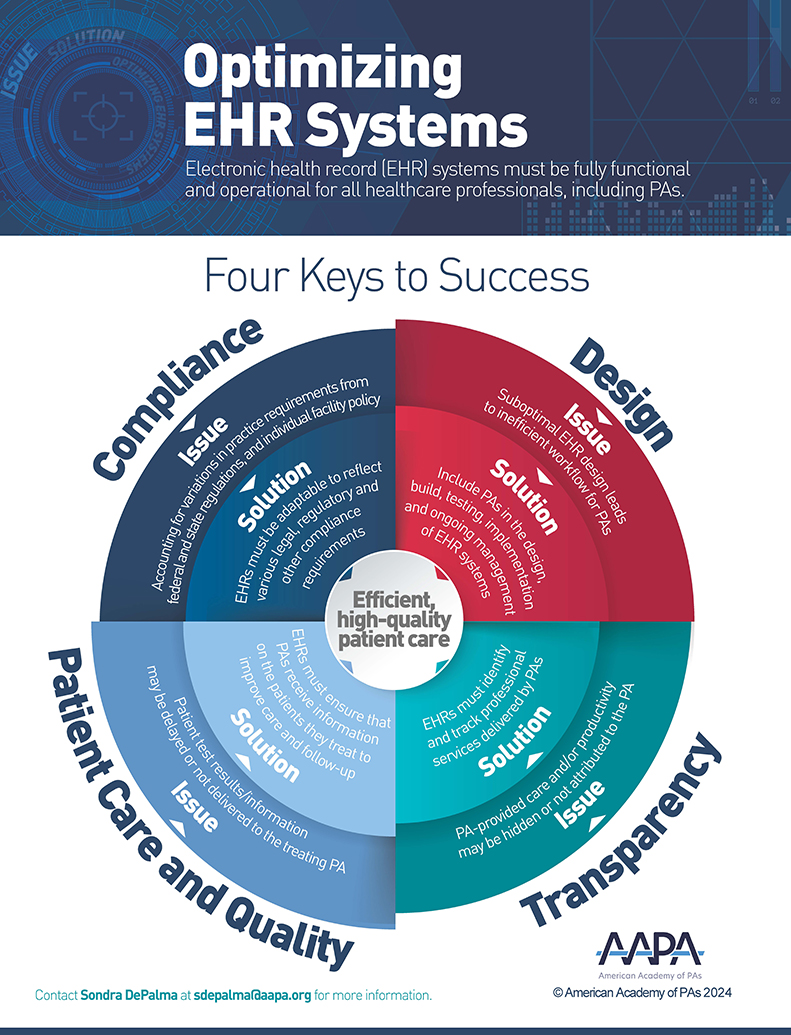
AAPA’s EHR Toolkit can help PAs advocate for EHR systems that are designed, selected, and implemented with functionality considerations for PAs, ultimately resulting in more efficient and high-quality patient care. AAPA’s EHR Toolkit contains five resources to help PAs. Contact Sondra DePalma at [email protected] for more information.
Best Practices Checklist for Your EHR System
Optimal PA Utilization of Electronic Health Records
- There is an individual or department in the organization with whom a PA can speak regarding questions or concerns about the design, implementation, or functionality of the electronic health record (EHR) system.
- All professional services delivered by a PA can be tracked and attributed to the PA via the EHR, even when those services are billed under a physician’s name (e.g., “incident to” or split (or shared) billing).
- A PA can obtain a report from the EHR system for all the services they rendered.
- The EHR system should recognize and incorporate payer billing requirements for PA-provided care to maximize legitimate revenue collection and reduce concerns surrounding fraud and abuse.
- The EHR system does not contain requirements that are more restrictive or prohibitive than federal or state law (e.g. co-signature requirements or limitations on writing orders/prescriptions), unless specified by practice or facility policy..
- If a PA practices in more than one specialty, the PA will have access to EHR functionality appropriate to their scope of practice and privileges for each specialty.
- If a physician co-signature is required, the professional services a PA provided and documented are attributed to the PA provider of service.
- A PA can view changes, corrections, and/or addendums to the patient’s medical record made by themselves and other health professionals with access to the medical record.
- Opportunities should be available to periodically review and modify the EHR system based on feedback from PAs and other health professionals to improve use, operability, and compliance.
Electronic Health Records and PAs:
Best Practices for EHR Vendors
PAs (physician assistants/associates) are state-licensed medical professionals who deliver medical and surgical services. PAs are integral members of the healthcare team and need access to electronic health records (EHRs) to effectively deliver care to patients.
PA Facts
- More than 168,000 PAs practice medicine and prescribe medication in all 50 states, the District of Columbia, U.S. territories, and the uniformed services.1 Employment of PAs is projected to grow 27% from 2022 to 2032, much faster than the average for all occupations..2
- PAs are responsible for an estimated 500 million patient interactions per year.1
- The Affordable Care Act recognized PAs as one of three primary care providers (along with nurse practitioners and physicians) and empowered PAs to lead patient-centered medical teams.
- PAs are individually credentialed and privileged by hospitals to deliver a wide range of medical and surgical services.
- In the office setting, PAs often have their own schedule and panel of patients, and practice autonomously.
EHR Best Practices
Healthcare practitioners need to utilize EHRs to provide medical care and achieve optimal care coordination. However, some EHRs are designed in a way that limits effective use by care providers, such as PAs. Such EHRs would benefit from modifications that encourage and facilitate PA-specific functionality, transparency, and regulatory compliance.
AAPA identified the following three principles to ensure effective EHR utilization:
1) EHR systems must be able to identify, track, and quantify work performed by PAs and other providers.
a. Requires accurate attribution of patients, orders, test results and care provided, even when a
service is performed in conjunction with, and billed under, a physician (e.g., “incident to” and split (or shared) billing).
b. Attribution of notes in a medical record should not be changed from the original author (e.g., the PA) if a different health professional subsequently treats the patient or modifies/makes addendum to the note.
2) EHR vendors must include PAs as part of the healthcare team that provides input into the design, build, testing, implementation, and ongoing management of EHR systems to identify key aspects of PA operability which might otherwise be overlooked.
3) EHR systems must be adaptable to consider the individual clinical practice requirements of each health professional, including PAs. Hospitals, medical practices and health systems must be able to modify levels of access granted, as well as EHR requirements, for all health professionals who use the EHR, including PAs, to account for a health professional’s specialty, scope of practice, and privileges.
When designed and implemented in a manner that properly accounts for PAs, EHRs can encourage transparency, improve quality, increase patient safety, enhance operational efficiencies, provide cost savings, and enrich patient satisfaction.
DOWNLOAD VENDORS’ BEST PRACTICES
- American Academy of Physician Associates. What is a PA? November 2023. org/download/80021/
- S. Bureau of Labor Statistics. Occupational Outlook Handbook: Physician Assistants. Accessed January 1, 2023. https://www.bls.gov/ooh/healthcare/physician-assistants.htm
EHR Talking Points for PA Discussion with Employers
EHR Design and Implementation
- EHRs should be designed with considerations for utilization, functionality, and efficiency by PAs and other health professionals. When appropriately designed and implemented for use by all relevant health professionals, EHRs can improve quality, increase patient safety, enhance operational efficiencies, provide cost savings, and increase patient satisfaction.
- PAs should be included as part of the team that provides input into the design, build, testing, implementation, and ongoing management of EHR systems. Without PA participation, key aspects of PA practice might be overlooked. These oversights are more difficult to correct once the system is fully designed and implemented as opposed to during the design phase.
- EHRs need to be adaptable to the specialty, scope of practice, and privileges of individual PAs. The type of EHR access granted should be able to be altered based on a PA’s specialty.
Transparency
- The professional work of PAs should be transparent and able to be identified through data captured by EHRs. This data should include patient encounters, as well as measure contribution to care delivery for non-reimbursed services (e.g. computerized order entry, patient care documentation, diagnostic review and follow-up, and patient communications). Care provided by PAs during “incident to” or split (or shared) visit billing should be identified as work performed by the PA.
Quality & Safety
- Improving healthcare quality and ensuring patient safety are potential benefits of EHRs. To do this, there needs to be accurate attribution of patients to PAs. EHRs need to ensure that orders and test results are appropriately attributed to the ordering PA. PAs also need to be able to accurately assess their panel of patients for population health management, compliance with quality measures, and self-assessment.
Compliance
- EHRs should reflect the regulatory requirements of federal, state and facility policy to ensure the maximum utilization of PAs while avoiding potential non-compliance.
- EHRs should ensure the recognition of a PA’s participation in patient care is not removed from the EHR when subsequent care is provided by another health professional or if an addendum is added to the medical record by another health professional.
Electronic Health Records and PAs: A White Paper
Executive Summary
The integration and inclusion of PAs (physician assistants/associates) in electronic health record (EHR) implementation and functionality is essential to achieve comprehensive care for individuals, better health for populations, and reduced healthcare costs. This can be achieved by addressing the EHR needs of PAs in the design and development of EHR software and during the readiness planning and implementation of EHR systems in all healthcare settings.
EHRs should be designed to contribute to transparency and measure the contribution of patient care provided by PAs. Methods of measuring the contribution of services provided by PAs should be incorporated into the functionality of EHRs. This identification of professional work is important for clinical assessment, practice improvement, measuring productivity and care contribution, and management of population health.
EHRs must be functional and have efficient workflows to gain provider acceptance and promote optimal patient care. Design-inefficiency for PAs and other healthcare practitioners may inhibit acceptance and adoption of EHRs, lead to noncompliance with regulations and institutional policies, and adversely affect patient care and health promotion.
EHRs and PAs
The EHR is transforming healthcare with the goals of achieving optimal, coordinated care for individuals and better health for populations. When appropriately designed and implemented, the value of EHRs has been demonstrated to improve quality, increase patient safety, improve operational efficiencies, provide cost savings, and improve patient experience and satisfaction.1,2
To achieve these benefits, EHRs must be fully functional and operational for all healthcare professionals, including PAs, who are integral members of the healthcare team. PAs provide care that would otherwise be delivered by physicians or nurse practitioners. There are PA-specific EHR needs in the areas of functionality, care attribution, transparency, and regulatory compliance. Currently accounting for about 10 percent of the healthcare provider workforce, the Bureau of Labor and Statistics projects a 27 percent increase in employment of PAs from 2022 to 2032.3 Due to the contribution of PAs to the provision of high-quality healthcare and the need to ensure efficient team practice, EHRs should be designed with specific functionality considerations for PAs. Optimal EHR functionality is essential for quality improvement, enhanced patient outcomes, accurate medical and legal documentation, compliance, transparency, research, and incentive-based payment programs.2
To accomplish these goals, EHR developers must consider the needs of PAs from the inception of software design. EHR vendors have historically focused on physician and nursing end-users when designing systems. Many vendors employ physicians and/or nurses to provide subject matter expertise at the front-end of development. Key PA attributes and functionality considerations might be overlooked by non-PA practitioners. This is problematic because development flaws and oversights are often difficult to correct once a system is fully designed and implemented. The needs of all end users of EHRs should be contemplated and reflected in system design and implementation to mitigate safety risks, achieve full functionality, and realize maximum benefits of use. 2, 4 PAs should be included as part of the team that is assembled to guide design, build, test, implement, and support EHRs.
Integrity and Transparency
Documentation integrity and the accurate attribution of contributions to the medical record are critical to ensure data accuracy, healthcare quality, and compliance. When there are multiple contributors to a document or medical record, all data entries should be clearly attributed to the individual who recorded the information, and all signatures and timestamps should be retained. If an EHR does not maintain data integrity or it lacks functionality to appropriately attribute the work of multiple providers, it may be impossible to verify the accuracy of data or the contributions of various practitioners.5
EHRs should be able to track the contribution of every clinician who provides professional services to patients. Because of “incident to”, split (or shared) billing, and different models of delivering team-based care, the contribution of a PA’s services may be unaccounted by traditional measures such as billing claims, relative value units (RVUs), or volume of services rendered. EHRs should design methods of measuring the contribution of services provided by PAs to ensure transparency in healthcare. This identification of professional work is important for clinical assessment, practice improvement, measuring productivity and care contribution, and management of population health.
Quality and Safety
Ensuring patient safety and healthcare quality is essential to improving individual and population health and reducing healthcare costs. Accurate attribution of patients, treatments, and diagnostic tests to a rendering provider is needed for self-assessment and quality improvement. In addition, to improve patient safety, the Office of the National Coordinator for Health Information Technology6 recommends that ordering providers be identified on all orders and diagnostic reports, be notified of results, and have result notifications remain in inboxes until addressed. Thus, to improve patient safety and quality outcomes, EHRs need to ensure that, when applicable, orders and test results are appropriately assigned to an ordering PA.
Resource Utilization and Reimbursement
An essential component of cost-effective care is accurate attribution of costs and the
resources expended for treatment to the responsible clinician. Attribution is needed for accurate, actionable data to result in reduced spending and efficient use of resources. In addition, assignment of responsibility for cost is increasingly important as the Centers for Medicare and Medicaid Services and private payers reimburse based on quality, episode-based payment models, and cost-savings incentives. To achieve accurate reimbursement and promote cost containment measures, it is essential that EHRs:
- attribute costs to the health professional who rendered the service and/or an ordering professional,
- measure contribution to care delivery for non-reimbursed services (e.g. computerized order entry, patient care documentation, diagnostic review and follow-up, and patient communications), and
- identify care provided by PAs during “incident to” billing, shared visit billing, and billing under a collaborating physician for Medicare, Medicaid, and commercial insurers.
Compliance and Operability
EHRs should be capable of complying with federal, state, and facility laws, regulations, and policies, and be flexible to allow for differences among facilities and states. For example, an individual health system may require a physician cosign a hospital admission order given by a PA. Other health systems may not require such a physician cosignature, or the same health system may not require a cosignature on orders other than an admission order. An EHR system should be customizable and only apply limitations or requirements where specifically needed, and not across the board (e.g., a requirement for a cosignature on one type of order should not be applied to other orders where not required). Otherwise, a lack of adaptability can lead to compliance concerns and unintended consequences of unnecessary work, which can undermine provider acceptance of EHRs, increase work and costs, and potentially result in patient harm.7
EHR operability and functionality considerations for PAs are particularly important for avoidance of fraud and abuse. The Office of Inspector General8 recommends EHR safeguards, including user logs and controls to validate claims submitted by rendering provider, to avoid fraud and the submission of false claims. EHRs also need to safeguard against the ability to change the authorship of a document to ensure an accurate medical-legal document and prohibit fraud, and a physician should not have the ability to edit a PA’s note as they would be able to do for a resident or fellow.
Conclusion
PAs are a critically important component to the delivery of efficient, high quality healthcare services. There are PA-specific issues that should be acknowledged to ensure effective EHR functionality, attribution, transparency, and statutory/regulatory compliance. Addressing the EHR needs of PAs is important both in the design and development of EHR software, and during the readiness planning and implementation of EHR systems in all healthcare settings. The full integration and inclusion of PAs in EHR system useability is essential to achieve comprehensive care for individuals, better health for populations, and reduced healthcare costs.
Contact Sondra DePalma at [email protected] for more information.
References
- Kruse CS, Stein A, Thomas H, Kaur H. The use of electronic health records to support population health: A systematic review of the literature. J Med Syst. 2018; 42(11): 214. doi: 1007/s10916-018-1075-6
- Tsai CH, Eghadam A, Davoody N, Wright G, Flowerday S, Koch S. Effects of electronic health record implantation and barriers to adoption and use: A scoping review and qualitative analysis of the content. Life. 2020; 10(12): 327. doi: 10.3390/life10120327
- S. Bureau of Labor Statistics. Occupational outlook handbook: Physician assistants. Accessed January 2, 2024. https://www.bls.gov/ooh/healthcare/physician-assistants.htm
- Fennelly O, Cunningham C, Grogan L, Cronin H, O’Shea C, Roche M, Lawlor F, O’Hare N. Successfully implementing a national electronic health record: A rapid umbrella review. Int J Med Inform. 2020; 144: 104281. doi: 10.1016/j.ijmedinf.2020.104281
- American Health Information Management Association. Integrity of the healthcare record: Best practices for EHR documentation. 2013. https://library.ahima.org/doc?oid=300257#.WYjSxlWGOpq
- Office of the National Coordinator for Health Information Technology. SAFER self-assessment: Test results reporting and follow-up. November 2016. https://www.healthit.gov/sites/default/files/safer_test_results_reporting.pdf
- Jones SS, Koppel R, Ridgely MS, Wu S, Palen TE, Harrison MI. Guide to reducing unintended consequences of electronic health records. RAND Corporation. August 2011. https://digital.ahrq.gov/sites/default/files/docs/publication/guide-to-reducing-unintended-consequences-of-electronic-health-records.pdf
- Office of Inspector General. Not all recommended fraud safeguards have been implemented in hospital EHR. December 2013. https://www.oig.hhs.gov/oei/reports/oei-01-11-00570.pdf