This PA Week, Students Share Their Vision for the Profession
AAPA President David J. Bunnell and Student Academy President Laura Hassan Visited Students Across Five PA Programs
October 12, 2026
By David J. Bunnell, PhD, PA-C, DFAAPA
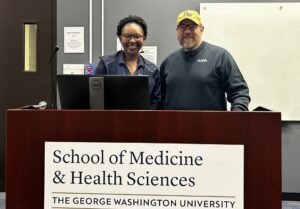
PA Week invites us to celebrate how far our profession has come and consider where we are going. This year, I wanted to hear directly from today’s PA students, who will help shape that future.
Student Academy President Laura Hassan and I visited hundreds of students across five PA programs: George Washington University, Howard University, Towson University, Notre Dame of Maryland University, and the University of Maryland, Baltimore.
The five institutions reflect the diversity of PA education, including public and private universities, longstanding and new PA programs, a historically Black university, and an institution grounded in a Catholic educational tradition. Each has its own history, mission, and community, illustrating the many pathways into our profession.



Laura brought a perspective closely connected to many of the issues students raised. A trained educator and recent graduate of the University of Maryland Eastern Shore, an HBCU, she now practices urology on Maryland’s rural Eastern Shore.
At each program, we asked students two questions:
- What do you hope the PA profession looks like ten years from now?
- What do you want today’s PA leaders to understand about you, your aspirations, and the communities you represent?
Many students expressed concerns about educational costs, scholarships, and changes in federal student loan programs. They asked about transitioning into practice, pursuing their chosen specialties, and building sustainable careers. Questions about the PA Licensure Compact reflected their interest in professional mobility, while discussions about compensation and practice environments revealed a desire for a collective voice in decisions affecting their work.


Other conversations explored the evolving role of artificial intelligence in healthcare and PA education. Students also asked how the profession can continue to reflect the diversity of the communities we serve. Some imagined providing care in medically underserved nations, while others hoped to bring the PA model to their countries of origin.
As an educator, I found the breadth of these conversations especially meaningful. I was struck by how students connected their immediate concerns about education and entering practice with broader questions about the profession’s future. They were not simply wondering what the profession might look like in ten years; they wanted to understand how they could contribute to shaping it. Their questions reflected an awareness that decisions about educational affordability, professional policy, and emerging technologies will shape their opportunities and careers.


I returned from these visits with a deeper appreciation for the perspectives students bring and greater confidence in the profession’s future. Their curiosity, ambitions, and willingness to engage with complex challenges reminded me that, as current PA leaders, we have a responsibility to listen, understand their aspirations, and create opportunities for students to participate in shaping the profession they will enter.
The future of the PA profession is not something we simply inherit. It is something we build together.
David J. Bunnell, PhD, PA-C, DFAAPA, is president and chair of the American Academy of Physician Associates. He is an associate professor and director of the Doctor of Medical Science Program at the University of Maryland School of Graduate Studies.
You May Also Like
This PA Week, Support the Next Generation of PAs
PA Student Loan Case Moves into Next Phase: What PAs and PA Students Need to Know
MEAPA President, Kathleen Moneghan, becomes an Excellence in Advocacy Honoree
You might also like
Thank you for reading AAPA’s News Central
You have 2 articles left this month. Create a free account to read more stories, or become a member for more access to exclusive benefits! Already have an account? Log in.