Clinical Resource Library Database
Use this searchable database to quickly find tools and resources to help you improve patient health.
APAOG Podcast: PT, Pessaries, and Surgery, oh my! Managing Pelvic Organ Prolapse
In this episode of the APAOG podcast, host Morgan Bechtel kicks off season four with an in-depth exploration of pelvic organ prolapse—a condition affecting millions of women but often shrouded in stigma and misunderstanding. Listeners… more
APAOG Podcast: Urogynecology with PA-C Debra Koenig
In this episode of the APAOG podcast, host Morgan Bechtel kicks off season four with an in-depth exploration of pelvic organ prolapse—a condition affecting millions of women but often shrouded in stigma and misunderstanding. Listeners… more
APAOG Podcast: You grew a what?! The physiologic changes of pregnancy
This course offers a comprehensive overview of the physiologic changes that occur during singleton pregnancy. PAs will explore adaptations across endocrine, cardiovascular, respiratory, hematologic, renal, and musculoskeletal systems to better understand and support pregnant patients…. more
Approach to the patient with a palpable breast mass
Breast mass is a common finding in patients presenting to primary care, women’s health, or urgent care clinics. PAs must know how to approach a patient with a palpable breast mass as well as what appropriate diagnostic evaluation is needed.
Approaches for Healthier Eating and Physical Activity
AAPA created this handout to help patients learn approaches for healthier eating and physical activity.
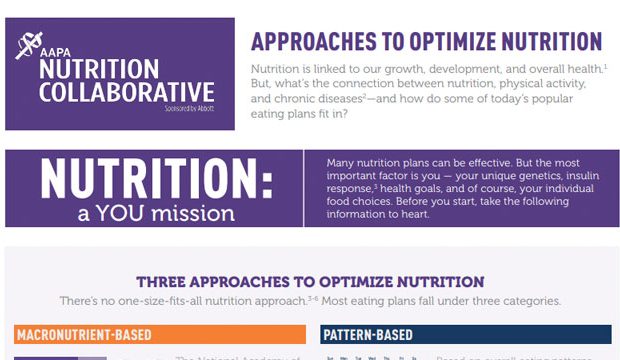
Approaches to Optimize Nutrition
This brochure provides an overview of the benefits and considerations of 3 nutrition approaches: Macronutrient-based, Pattern-based, and Calorie-restricted, along with examples of popular diets that fall under each.
Are beta-blockers safe and effective after myocardial infarction in patients with COPD?
Clinicians may be hesitant to prescribe beta-blockers in patients with chronic obstructive pulmonary disease (COPD) who have a comorbid compelling cardiovascular indication for beta-blocker therapy. This article summarizes the available data on the safety and efficacy of beta-blockers in patients with COPD and recent myocardial infarction.
Around the Horn on Obesity Management: Identifying Real-World Solutions to Long-Term Challenges
In the United States, overweight and obesity are highly prevalent, with 70% of American adults affected by either condition. Overweight and obesity are associated with multiple potential medical complications, including metabolic-associated steatohepatitis (MASH), osteoarthritis, obstructive… more

ASH Clinical Practice Guidelines
American Society of Hematology guidelines are developed by leading clinical, methodological, and patient experts through a rigorous process to review evidence and write actionable recommendations.
ASPEN Nutrition Science & Practice Conference: March 22-25, 2025
The annual meeting of the American Society for Parenteral and Enteral Nutrition.
Assessment and Management of Patients at Risk for Suicide VA/DoD (2024)
Developed by the U.S. Department of Veterans Affairs (VA) and & Department of Defense (DoD), this Clinical Practice Guideline can be used by community providers and others in the health care team involved with the assessment and management of adult patients at acute risk for suicide.
Association for Size Diversity and Health (ASDH)
A non-profit organization with an international membership committed to the practice of the Health At Every Size® (HAES®) Principles.
Association of Diabetes Care & Education Specialists (ADCES)
The Association of Diabetes Care & Education Specialists (ADCES) is an interprofessional membership organization dedicated to improving prediabetes, diabetes and cardiometabolic care through innovative education, management and support.
Association of PAs in Cardiology
Enhancing the personal and professional growth of its constituent members and all physician associates practicing in the Cardiology specialty through educational opportunities, community involvement, and political representation and advocacy.
Association of PAs in Psychiatry
APAP is a nonprofit organization for all PAs who encounter patients with mental health concerns.